ESC

What are you looking for?

ESC

What are you looking for?

Shopping cart

Your favorites

You have not yet added any recipe to your favorites list.

Browse recipes

Schedule your 15-minute demo now

We’ll tailor your demo to your immediate needs and answer all your questions. Get ready to see how it works!

0
0
×

School E-Shop

Smart Parking Design for Schools

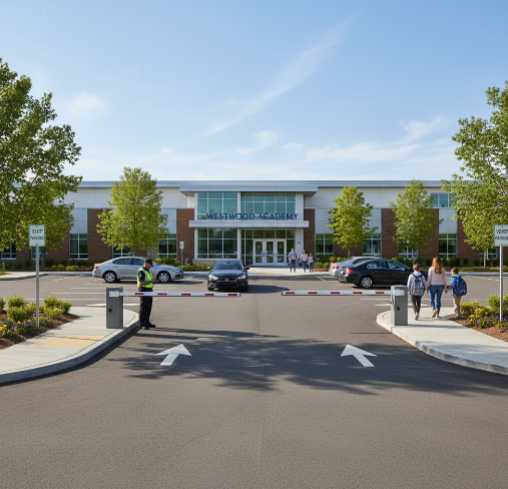
Designing an effective vehicle access parking system is one of the most practical ways schools can improve daily safety. A well-planned layout protects students during peak traffic times, reduces congestion, and gives staff and parents confidence in the school’s safety standards.

A good system starts with a clear understanding of the school’s unique needs. Leaders should consider school size, number of students and staff, staggered timings, and nearby road conditions. Conducting a basic traffic flow analysis—observing arrival and dispersal patterns, identifying choke points, and mapping entry/exit routes—helps schools design a parking plan that is realistic and safe.

Segregation of parking areas is critical. Staff parking should be placed in a secure, less busy section, ideally with restricted access such as RFID tags or access cards. Visitor parking must be close enough for easy supervision, with a controlled entry process at the main gate. Student drop-off and pick-up zones should be wide, clearly marked, and designed for continuous movement so vehicles do not idle or double-park. Handicap-accessible bays must be near the entrance, wide, well-marked, and compliant with local regulations.

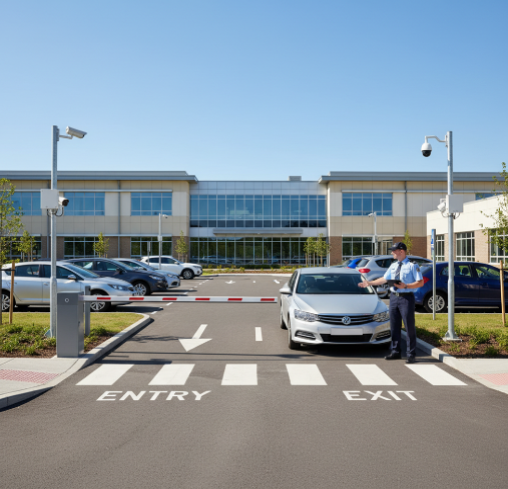
Technology can significantly strengthen vehicle access control. Automated gates reduce manual errors and unauthorized entry. RFID tags, keypad systems, or license plate recognition help identify vehicles and log movements. CCTV cameras at all entry, exit, and critical parking zones not only deter unsafe behavior but also provide evidence in case of incidents. Where possible, integrating access systems with visitor management software further enhances accountability.

Clear signage and proper lighting transform a parking area from confusing to intuitive. Directional arrows, painted lanes, speed limit signs, and labeled zones (“Staff Only,” “Drop-Off Only,” “Visitor Parking”) guide drivers and reduce last-minute lane changes. Adequate, uniform lighting improves visibility during early mornings, evenings, and poor weather, lowering accident risks and discouraging trespassing.

A parking system is not “set and forget.” Regular maintenance is essential: checking gate operation, testing CCTV coverage, replacing faded paint, fixing broken lights, and updating software for access systems. Schools should also review their parking plan after any major change—such as increased enrolment, construction, or route changes—and conduct periodic drills or orientations for new parents and staff.

When schools invest in thoughtful vehicle access and parking design, they reduce daily chaos and significantly improve student safety. A secure, well-organized parking environment sends a clear message: safety is planned, not left to chance.

School leaders should review their current parking and access setup at least once a year, consult safety experts where needed, and involve parents, security staff, and transport providers in improving traffic flow and safety around the campus.

Prev Article
The Importance of Vehicle Access Parking in Enhancing School Safety
Next Article
How Smart Vehicle Access Parking Makes School Campuses Safer

Related to this topic:

rocket-icon rocket-icon rocket-icon

Learn What Makes Schools Truly Safe

Receive safety guides, policy updates, and best practices from global experts.

We care about your Personnel Data. Please check Privacy Policy